Quantcast
Berkeley Lab

May is Electrical Safety Month at DOE

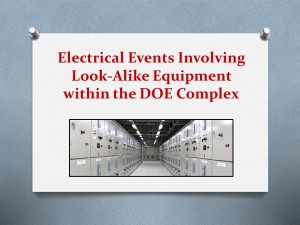
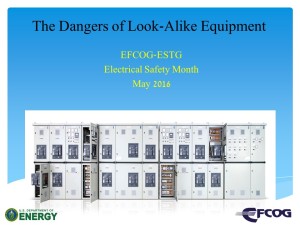
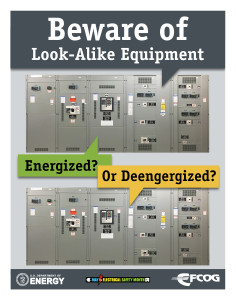
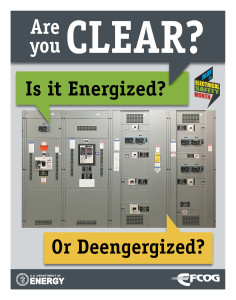
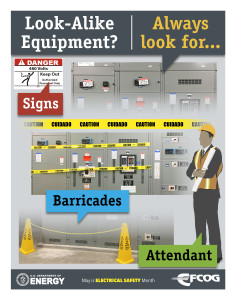
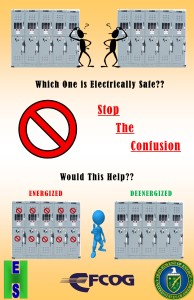
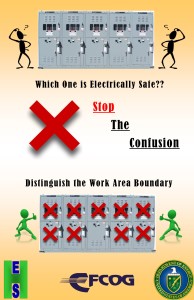
The electrical industry established May as National Electrical Safety Month many years ago, and, according to the Electrical Safety Foundation International (ESFI), May is the time to begin year-round electrical safety awareness efforts. This year, the Department of Energy (DOE), through the efforts of the Energy Facility Contractors Group (EFCOG), is planning to participate by focusing on “Look Alike Equipment” throughout the month.

In 2010, a sharp increase in electrical safety events beginning in 2009 caught the interest of the EFCOG Electrical Safety Subgroup (EFCOG ESSG), so the subgroup chartered a Hazardous Energy Control (HEC) subcommittee to analyze the events.  The subcommittee’s efforts ultimately resulted in the May 2011 Electrical Safety Month campaign for the DOE Complex. The subcommittee continues this year with another effort focused on look alike equipment. Use the links below for this year’s materials.  We encourage you to disseminate this information among your fellow workers.

PowerPoint (Click to download)
Look-A-Like 01PPTX Look-A-Like 02PPTX
Summary of DOE Complex Electrical Events Involving Look Alike – 2016   The Dangers of Look Alike Equipment – 2016
Posters (Click to download)
Look-A-Like Poster 01 Look-A-Like Poster 02
Look-A-Like Poster 03 Stop the Confusion 01
Stop the Confusion 02

Additional Information Available

This year’s ESFI campaign features Electrical Safety Illustrated magazine, which discusses timely electrical safety issues and equips consumers with the knowledge to protect their homes, families, and communities from electrical hazards.

The National Fire Protection Association (NFPA) estimates 47,700 home structure fires reported to U.S. fire departments each year involve some type of electrical failure or malfunction as a factor contributing to ignition. These fires result in 418 civilian deaths, 1,570 civilian injuries, and $1.4 billion in direct property damage.  Awareness and education are critical to reduce the incidence of electrical fires, and ESFI sponsors National Electrical Safety Month each May to educate the public in order to reduce the number of electrically related fires, fatalities, injuries and property loss.

Many electrocutions and home fires can be prevented by understanding basic electrical safety principles and by taking simple precautions.  This year’s campaign features a collection of easily sharable safety resources that provide a fundamental understanding of electrical safety to encourage everyone to use electricity and electrical equipment safely.

Electrical Safety Illustrated features content which includes resources that provide an illustrated guide that break downs the importance of arc fault circuit interrupters (AFCIs), extension cord safety, Test Before Touch, and Lockout/Tagout.

Help champion the cause of minimizing electrically-related deaths and injuries by sharing this information with co-workers, friends and family, and by checking both your home and workplace for electrical hazards!
Electrical Safety Month ESFI website

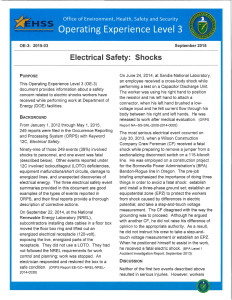
Operating Experience Level 3 – Electrical Safety: Shocks

OE-3 2015-03_Page_1This Operating Experience Level 3 (OE-3) document provides information about a safety concern related to electric shocks workers have received while performing work at Department of Energy (DOE) facilities.

From January 1, 2012 through May 1, 2015, 249 reports were filed in the Occurrence Reporting and Processing System (ORPS) with Keyword 12C, Electrical Safety.

Click the document image to download this alert.

Safety Alert 2015-005: Non-NRTL MacBook Power Adapter Catches Fire

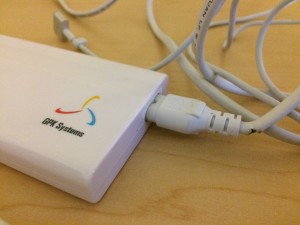
Mac Book Power Adapter

A GPK Systems (after market, non-NRTL) MacBook power adapter was plugged in to a 120-Volt outlet when it began to flame and smoke. The adapter was unplugged, stopping the fire, but leaving soot on the table.

The stress point on the cord appears to have weakened the wire, causing heat to build up and eventually caused a fire.

Download Safety Alert 2015-005: Non-NRTL MacBook Power Adapter Catches Fire

Safety Alert 2015-004: Worker Shocked by Loose Plug

Loose Plug 01

An Electronics Engineering Technologist received a 120 VAC minor electrical shock to the right index finger.

A portable work light was plugged into a rack-mounted outlet strip. The plug had backed out partially from the receptacle. When the employee reached in to perform work, they did not see this condition and their fingertip brushed up against the exposed, energized prong of the plug.

The outlet strip is inside and facing towards the front of the cabinet.

The employee immediately reported the shock and was sent to medical for evaluation. Following an EKG with no abnormalities detected, the employee was released with no injury.

Download Safety Alert 2015-004: Worker Shocked by Loose Plug

Safety Alert 2015-003: Apple Power Adapter Breaks in Outlet When Unplugged

IMG_1199The blade sticking out of the pictured outlet is from a power adapter that was powering an Apple (Mac) laptop, plugged into a 120-Volt outlet. When the user, a Network Engineer, attempted to unplug the power adapter from the outlet, the blade in the “hot” side of the outlet broke free of the power adapter and remained in the outlet.

This condition presented a serious shock hazard to the user. Had he not been attentive to the equipment condition, a serious injury could have occurred. While this incident occurred at home, the proliferation of Apple-branded products encouraged the Network Engineer to share the experience with co-workers.

Download Safety Alert 2015-003: Apple Power Adapter

Line crew’s safety training saves infant’s life

baby-300
“We go to CPR training every year, and we’re always told that we’ll use it more away from work than at work,” said Arty Mayfield of Vacaville, California. “This is what we do. This is what we’re trained to do.”

Mayfield, a member of the International Brotherhood of Electrical Workers (IBEW) Local 1245 and five other members of a Pacific Gas and Electric line crew recently put their life-savings skills to work, helping to save a nine-month old infant from choking.

(In the photo at right, Kurt Kidwell holds the baby he and his co-workers saved from choking. Photo by Dustin James.)

Read the full article on the ISHN website.
If you don’t already subscribe to ISHN, it’s a great FREE resource! Consider Subscribing.

Download a PDF version of the article HERE.

ASTM D-120 Updated

astm_international_75687ASTM D-120 has been updated to version “-14a”, approved Nov 1, 2014 and effective December 2014.

ASTM D-120-14a, Standard Specification for Rubber Insulating Gloves

The update changes the wording of Section 18.4.1.2 to allow for electrical testing of gloves to be performed using either a true-“RMS or average responding” voltmeter.  The previous edition wording used antiquated language of “RMS responding voltmeter”, and was found to confuse users of the standard.

ASTM standards are viewable through our Resources page.

An article on the differences of True-RMS vs Average-Responding meters

What does it mean to be a “QEW”, or “Qualified Electrical Worker”?

Let’s start by looking at the LBNL definition of “Qualified Electrical Worker”:

One who has demonstrated skills and knowledge related to the construction and operation of electrical equipment and installations, has received safety training to identify and avoid the hazards involved, and who has been approved or accepted by the Electrical AHJ for Safe Work Practices.

This definition is based on the NFPA 70E (Standard for Electrical Safety in the Workplace), National Electrical Code, and OSHA definitions of “Qualified Person”.

Furthermore, the definition of “electrical equipment” is:

A general term, including, fittings, devices [Definition: A unit of an electrical system, other than a conductor, that carries or controls electric energy as its principal function.], appliances, luminaires, apparatus, machinery, and the like, used as a part of, or in connection with, an electrical installation.

Any employee and/or subcontractor [worker] who performs work [activities related to employment of any type at LBL] on hazardous [50V or greater, or 5mA or greater for AC power, other thresholds may apply for other electrical hazards and power types] electrical equipment is required to be a QEW. This includes both live and deenergized work, for build, service, maintenance, and repair of equipment.

Being a QEW does not mean you are an electrician. From NFPA 70E, Section 110.4(D)(1)(a):

A person can be considered qualified with respect to certain equipment and methods but still be unqualified for others.

LBNL has several levels of QEW. Just as some LBNL electricians are QEWs for general Facilities electrical installation work, but are not qualified to work on the high-voltage distribution system, some researchers can be qualified for working on specific R&D equipment within their labs, but would not be qualified to perform Facilities repair and installation.

I’m not an electrician! Why do I have to follow all these requirements? Aren’t safe work practices just for electricians?

Electricity is used by everyone…it is all around us, all the time. So, first and foremost, we all need to follow electrical safe work practices to ensure our safety while we work on or around electricity and electrical equipment.

Additionally, 10 CFR 851 and LBNL’s contract with DOE incorporate NFPA 70E requirements.

From NFPA 70E, Section 90.1:

The purpose of this standard is to provide a practical safe working area for employees relative to the hazards arising from the use of electricity.

From NFPA 70E, Section 90.2(A):

This standard addresses electrical safety-related work practices, safety-related maintenance requirements, and other administrative controls for employee workplaces that are necessary for the practical safeguarding of employees relative to the hazards associated with electrical energy during activities such as the installation, inspection, operation, maintenance, and demolition of electric conductors, electric equipment, signaling and communications conductors and equipment, and raceways. This standard also includes safe work practices for employees performing other work activities that can expose them to electrical hazards

Informational Note: This standard addresses safety of workers whose job responsibilities entail interaction with electrical equipment and systems with potential exposure to energized electrical equipment and circuit parts. Concepts in this standard are often adapted to other workers whose exposure to electrical hazards is unintentional or not recognized as part of their job responsibilities. The highest risk for injury from electrical hazards for other workers involve unintentional contact with overhead power lines and electric shock from machines, tools, and appliances.

These electrical safe work practices are for everyone!

I just build or repair electrical equipment! Why do I have to be a QEW?

Most importantly, when you build or repair a piece of equipment that you or others will use, you have a responsibility to provide equipment that is safe for its intended use. You have a big responsibility, as you become responsible for someone’s health and life! Part of being a QEW is being familiar with the construction and operation of equipment; that familiarity allows you build or repair equipment responsibly.

Additionally, equipment is required to be built and/or repaired according to numerous applicable codes and standards, such as those produced by UL (Underwriter’s Laboratories), IEEE (Institute of Electrical and Electronics Engineers), and NFPA (National Fire Protection Association), just to name a few. A person who builds or repairs equipment must be knowledgeable these standards and requirements. Approval as a QEW helps ensure that a person has this knowledge.